children, and a more industrious place than the schoolroom during the hours of “occupations” it would be hard to discover.
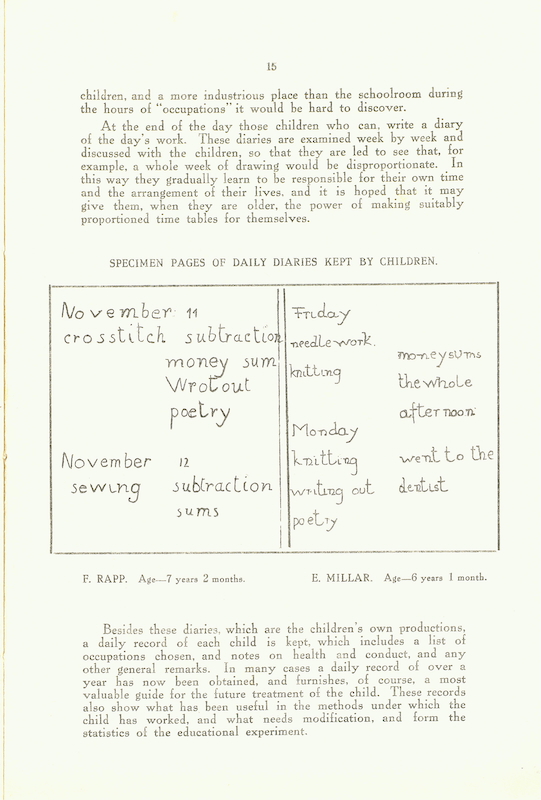
At the end of the day those children who can, write a diary of the day’s work. These diaries are examined week by week and discussed with the children, so that they are led to see that, for example, a whole week of drawing would be disproportionate. In this way they gradually learn to be responsible for their own time and the arrangement of their lives, and it is hoped that it may give them, when they are older, the power of making suitably proportioned time tables for themselves.
SPECIMEN PAGES OF DAILY DIARIES KEPT BY CHILDREN.
|
November 11 crosstitch subtraction money sum Wrot out poetry November 12 sewing subtraction sums |
Friday needlework moneysums knitting the whole afternoon Monday knitting went to the writing out dentist poetry |
F. RAPP, Age—7 years 2 months. E. MILLAR. Age—8 years 1 month.
Besides these diaries, which are the children’s own productions, a daily record oi each child, is kept, which includes a list of occupations chosen, and notes on health and conduct, and any other general remarks, in many cases a daily record of over a year has now been obtained, and furnishes, of course, a most valuable guide for the future treatment of the child. These records also show what has been useful in the methods under which the child has worked, and what needs modification, and form the statistics of the educational experiment.