6. The Junior School 2: Joan Watson
Relatively few will remember Miss Joan Watson, who had charge of the middle class. My year with her was her last and she had not been there very long, so I daresay she was at Caldecott for not more than four or five years. Unlike Mrs. Robson and Mr. Draper, and later Miss Morris and Miss Devenish, she stuck strictly to her job description. She had a cottage a bus-ride away, somewhere beyond Sellindge – not one of the Brabourne estate cottages where the teaching staff were usually housed. She did not stay on for supper in the house or stand in for the house staff on their days off, or join in house activities generally. I remember Miss Watson’s cottage because, in the run-up to her departure, some of us went to help her pack her things into boxes. She had a piano there, and part of the wall had to be taken down and rebuilt to get it in and out. We were plied with drinks and cakes for our services, and found it curious how nice some of the grimmer members of staff could be – when they were leaving.
I have to say that Miss Watson was not especially loved. Nicknames can be revealing. “Cloey” (Mike Clover), “Bing” or “Bingy” (James King), “Robbie” (Mrs. Robson), “Droopy” (Mr. Draper), even “Ruhly” (Miss Ruhl) and “Aggie” (Miss Travers) all imply a certain affection. “Wotty” somehow rings differently. She had a rich, head-nurse sort of voice and a rather stiff deportment. After Miss Robson’s much more imaginative teaching, the move to Miss Watson’s class seemed a move backwards. She was a firm believer in the “three Rs” (reading, ’riting and ’rithmetic”). Nothing wrong with that, but she failed to make them very attractive.
Yet there was more to “Wotty”. She had her arts and crafts side. I remember her for three things.
Firstly, dancing, which I hated.
Secondly knitting. As I mentioned, I learnt some basic knitting with Miss Murdin, but with Miss Watson I mastered a range of different stitches and even learnt to follow a pattern. I left behind me the world of scarves and egg-cosies. My masterpiece was a navy-blue Balaclava helmet I later proudly lent to a staff member, David Carver, for an afternoon’s tobogganing. I never saw it again. Mr. Carver remarked blandly that he did not know where it was. I left part of myself with that Balaclava helmet.
Then there were the bamboo pipes. Guided by Miss Watson, we cut down a stick of bamboo to the right size, bored holes in it, gave it a cork mouthpiece and, lastly, painted it a pretty colour. Lo and behold, we had a sweet-toned instrument which could play a scale like a recorder. I still have 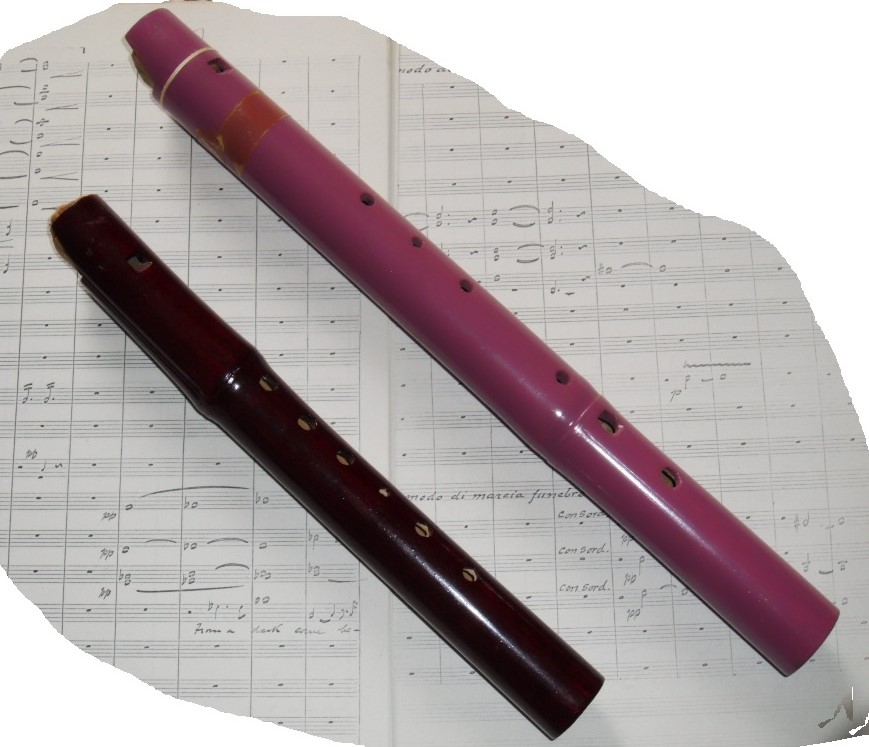 two, similar in pitch to a descant and a treble recorder. Miss Watson herself had a lower-pitched one and got some sort of ensemble work out of us. As each hole was bored, Miss Watson sent us over to Betty Rayment to check the tuning. “Flat as a pancake” was her inevitable remark, but with a little more filing at the hole we succeeded in satisfying her. Taking them out today, I find them too out of tune to give any pleasure. Fifty years of heat and damp must have warped the wood and wrought havoc with the tuning. A pity, because the sound they make is still sweet and true and they look very pretty. I may not have appreciated Miss Watson’s “Three Rs” greatly but I do have these nice souvenirs of the work we did with her.