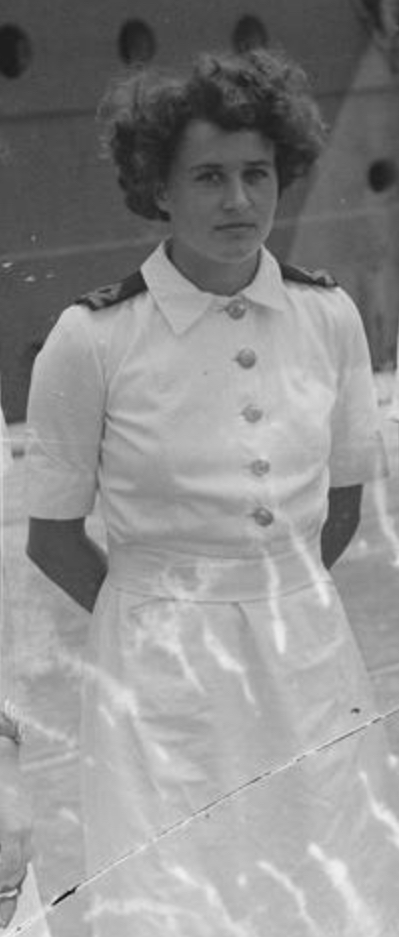
Third Officer Audrey Sylvia Coningham, 1942
Photograph on glass plate taken by Lt. E.E. Allen
Admiralty Official Collection
Imperial War Museum.
Anne's Mother
The obituary of Audrey Roche published in the Daily Telegraph on February 5, 2009 [behind a paywall, but largely reprinted in "Snippets/Pictures from the past" (see below)], begins:
"Audrey Roche, who died on January 13 aged 90, is thought to have been the only woman decorated for bravery at sea during the Second World War; as a Wren whose ship had been torpedoed, she saved the life of a drowning seaman by giving him her lifebelt, and she was mentioned in despatches."
This was in 1942, and the longer and fuller story, because of its significance, is captured in a number of sources, the most extensive of which is probably the 2020 book "Sisters in Arms" by Jeremy Crang (see below). The Telegraph obituary sets the scene:
"She had been swimming for between 15 and 30 minutes when she saw two men clinging together. Only one had a lifebelt, and he was supporting the other, whose head kept disappearing beneath the waves."
The primary job of the Allied ships which had been accompanying theirs before it was sunk was to hunt down the submarine. There was no way to know how long the ships would be before they could return. In the water, there was no way to know how long it would be before help came.
Audrey had learned lifesaving at her convent school, Ursuline High School in Brentwood, and had passed all the examinations of the Royal Life Saving Society; factors which were important in what she was able to do, and became significant in another way later, when what she had done - as a woman - were assessed and processed in London, in relation to the honours she should be awarded.
Having seen the two men struggling, Audrey swam to them, and though Leading Seaman Leslie Crossman, the sailor without a lifebelt, was injured, she was assured they were okay. They weren't, and after a while, and with the help of a male officer swimming near, gave and put her lifebelt on Crossman. "Lie still" she told him. "You’ll be all right. Trust me".
She then swam to the Zulu, a destroyer in the vicinity, where after another twenty minutes in the water, she was finally picked up. The obituary tells us that the smallest sailor on board lent his spare shirt and shorts "to dress her". The Zulu then went hunting. This, Audrey's ultimate disembarcation in Haifa, and a period on shore - where she overcame her resistance to getting back into the water (and when Anne was conceived, although this is not in the story)- are discussed in her 1993 interview for the Imperial War Museum (see below).
Both men were saved. It was clear Audrey's action had saved Crossman's life, and her gallantry and what she had achieved were immediately recognised by those in the theatre. However -
"Despite a recommendation from senior officers on the spot, and the strong, personal support of Admiral Sir Henry Harwood, Commander-in-Chief Mediterranean, for the immediate award of the Albert Medal (since replaced by the George Cross), it took the Honours and Awards Committee in London six months to deliberate. Eventually it was held that – as a strong swimmer – Coningham had not put her own life at risk, and that the witness to her bravery had helped in the rescue."
Instead, she was "awarded a mention in despatches" and - emphasis added - " 'some publicity' " (see Some Publicity below).
*
In her oral history recorded in 1993, Audrey said she had gone to Australia shortly before the war at the invitation of her brother's godfather, who was on his way to Australia as a military liaison officer. Her obituary in the Telegraph says she was working as a ranchhand in New South Wales when the war itself began; and in the 1993 interview she said that having been advised that the war would be quickly over, but then having seen Christmas come and go, she left Australia for England in the Spring of 1940, where she joined the Women's Royal Naval Service. See Houterman & Koppes, below, for outline details of her service.
Also according to Houterman & Koppes, she and Maj. David John Hugh Roche of the Indian Army married in Weston-super-Mare in England in 1946. According to the obituary they were in India until Partition in 1947, and again according to the obituary they arrived in Nairobi after a long overland journey in 1951 ("As a keen golfer, she represented Kenya in international competitions and continued to play into her seventies"), with two young children. They returned to England in 1975.
Anne's childhood memory of spending part of a summer holiday with the couple and their, then, two young children suggests the Roches lived for a time in England, presumably after leaving India in 1947, when Anne would have been 3 or 4, and before their move to Kenya in 1951, when she would have been 7 or 8. The overland journey from France to Nairobi as described in the obituary, which sequentially follows directly in the obituary from their leaving India, as if that was their starting point, would then make sense. Houterman & Koppes, by the way, say that they emigrated to Kenya in 1947. Anne says she last saw her mother when she was about six, or around 1949. Anne's own story is here.
The Telegraph obituary culminates with a question Audrey was asked in 2003 - whether "being in the Wrens was the most important part of her life" - to which she replied "Good heavens, no. My family is the best time of my life". The obituary ends with "She is survived by her five children." But it does not say whether that includes Anne.
ANNE'S MOTHER IN NEWSPAPER REPORTS
1935
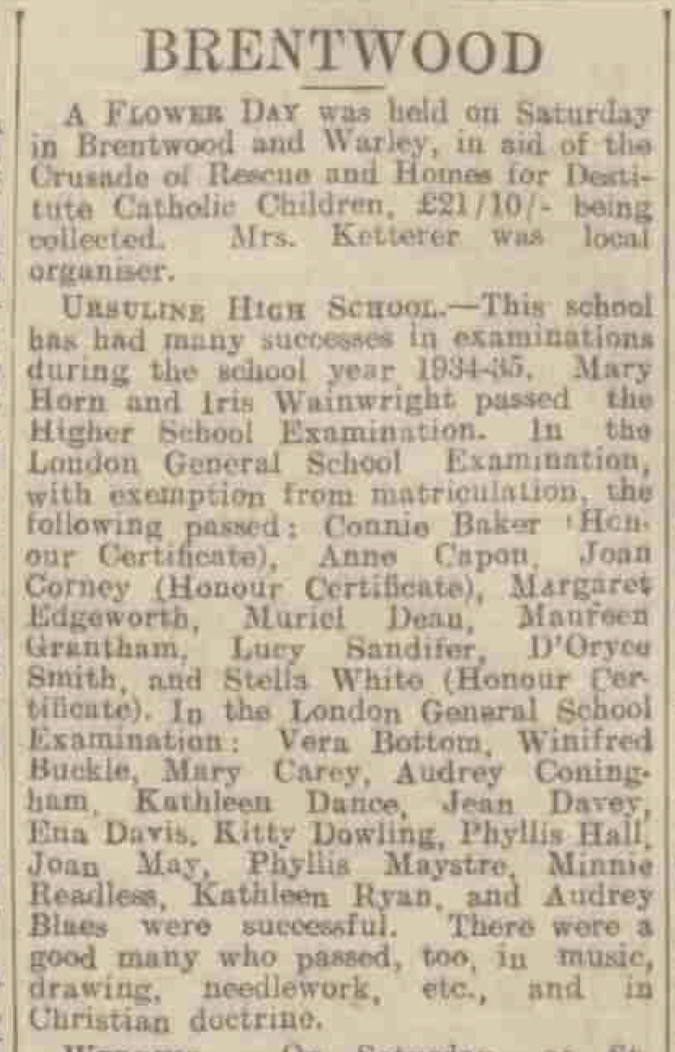
Brentwood/Ursuline High School
The Essex Chronicle, September 20, 1935, page 12
1943: 'Some Publicity' - England
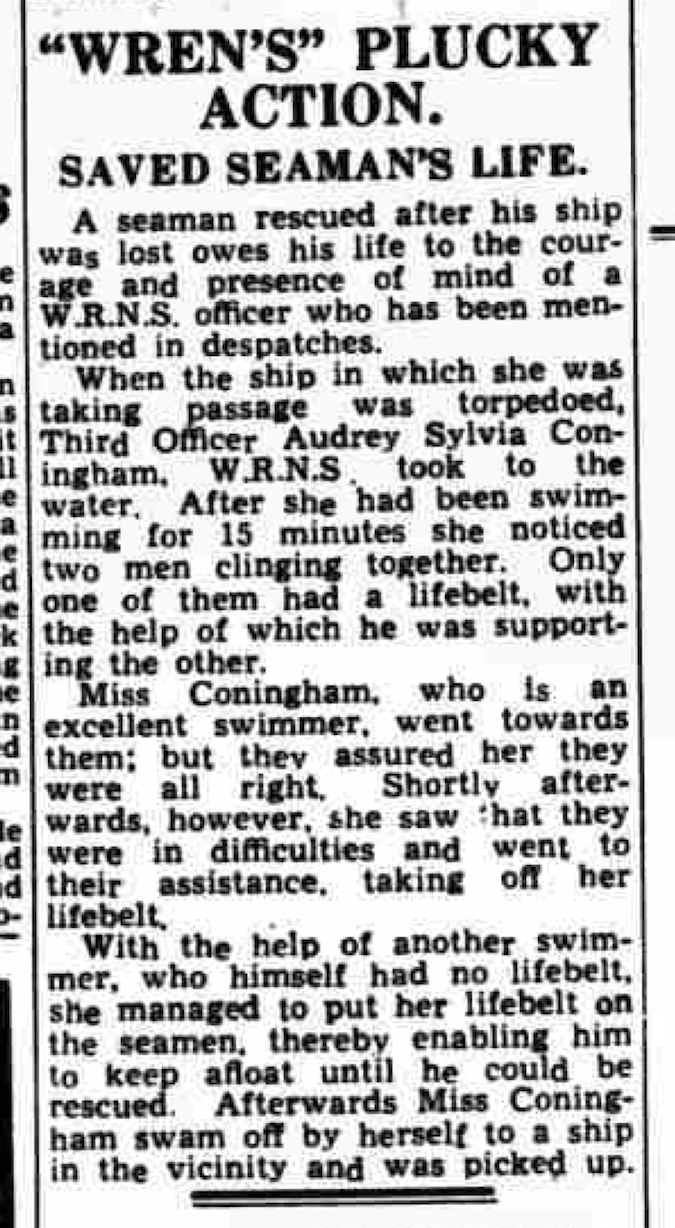
"Wren's" Plucky Action. Saved Seaman's Life
The Belfast Telegraph, January 6, 1943, page 6
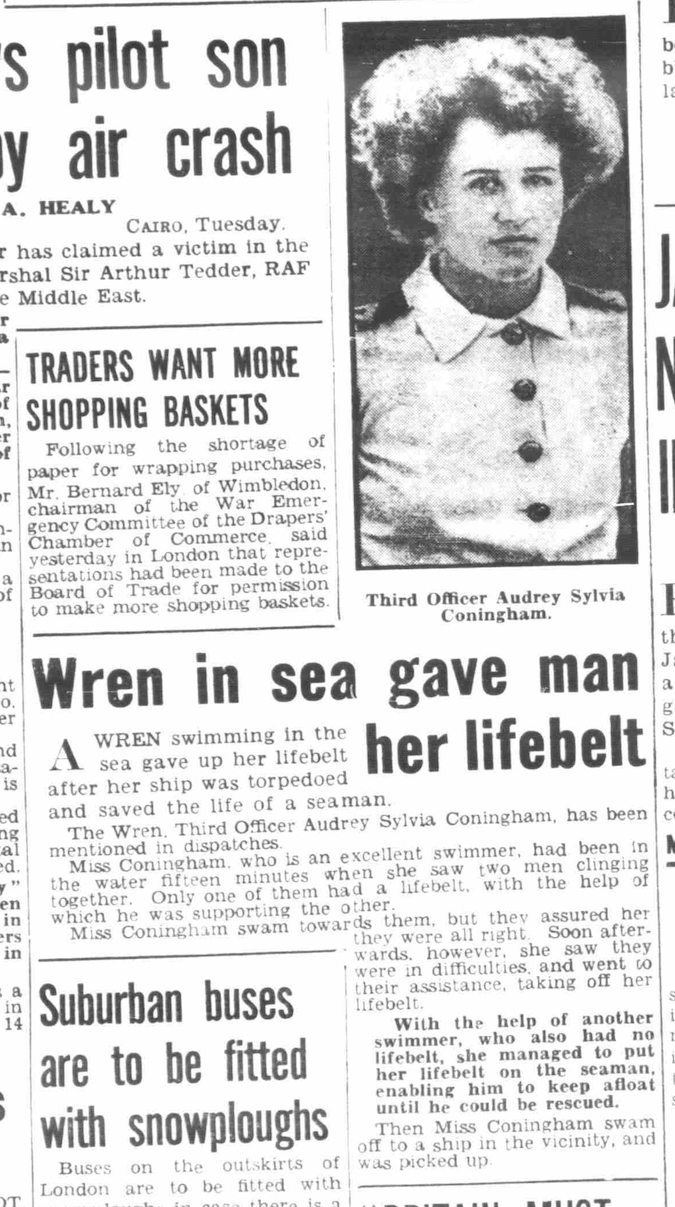
Wren in sea gave man her lifebelt
The Daily Mirror, January 6, 1943, page 8
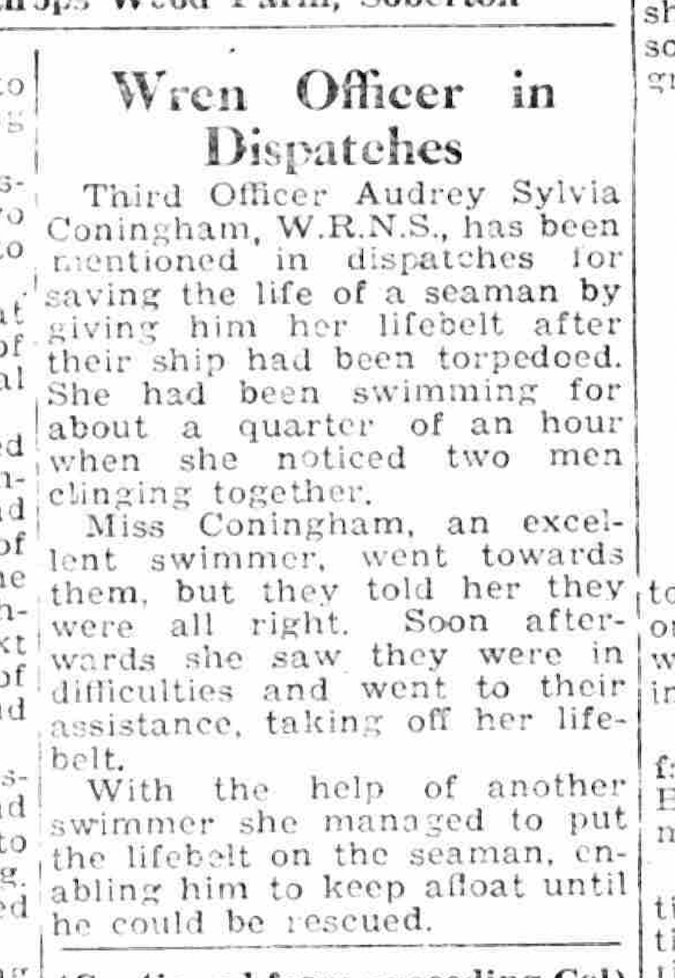
Wren Officer in Dispatches
The Evening News, January 6, 1943, page 4
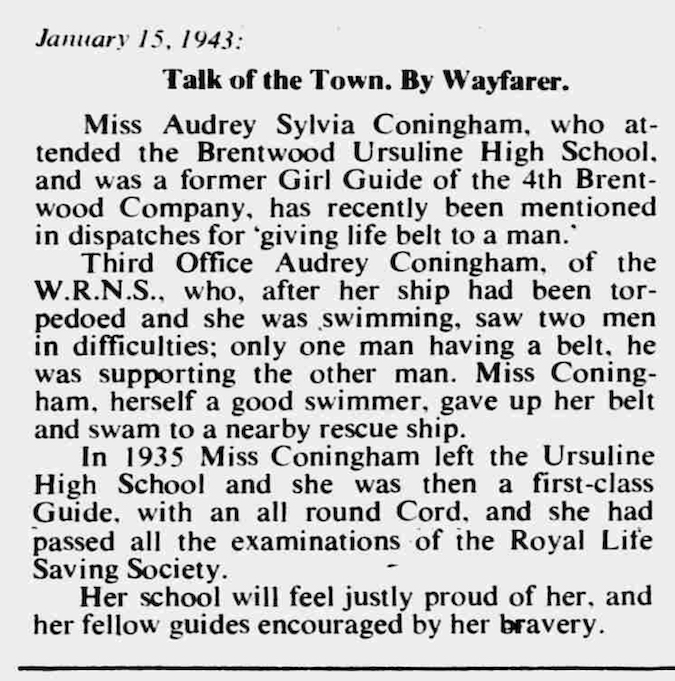
Talk of the Town. By Wayfarer.
originally: January 15, 1943
reprinted in:Brentwood Gazette and Middlesex Recorder, October 24, 1969, page 42
1943: 'Some Publicity' - Australia

Australian Woman in WRNS Saves Man's Life
Melbourne Argus, January 7, 1943, page 12
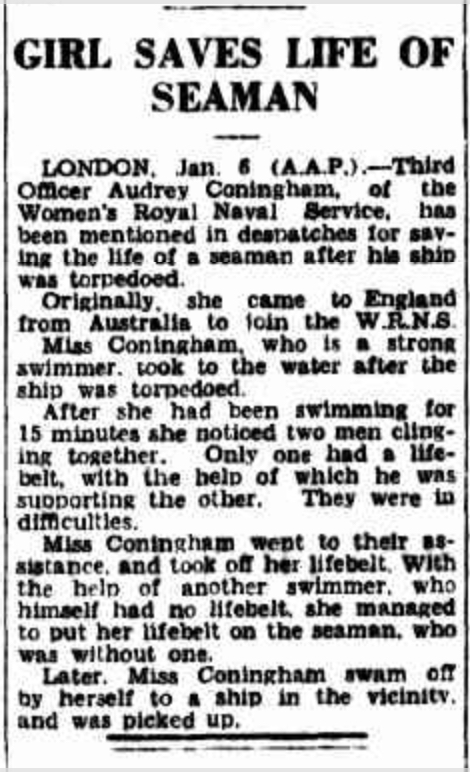
Girl Saves Life of Seaman
Sydney Morning Herald, January 7, 1943, page 6
1986: After-Life of a Good Deed
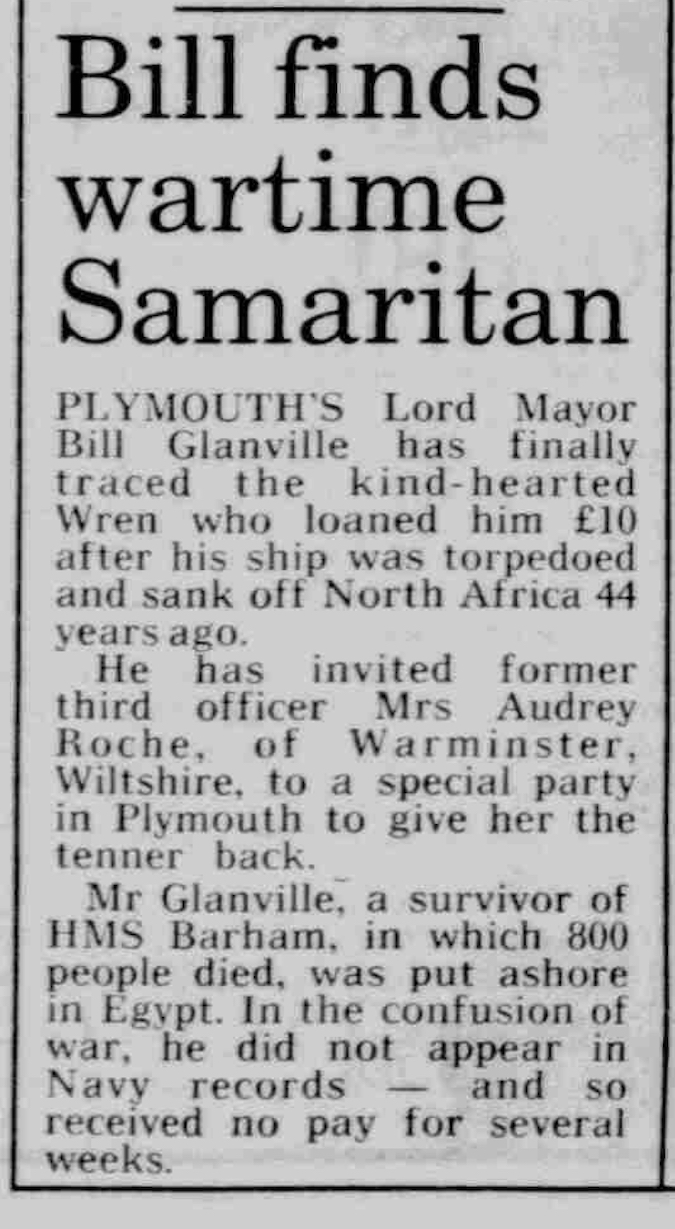
Bill finds wartime Samaritan
Daily Post, November 8, 1986, page 6
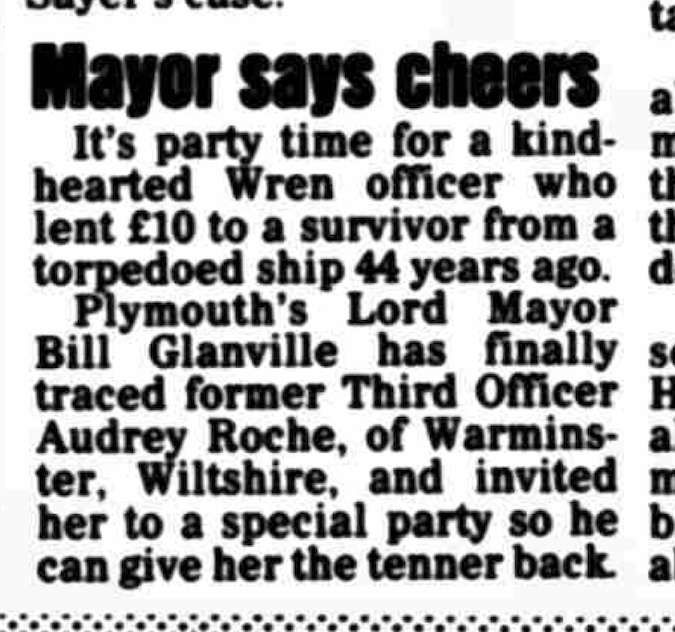
Mayor says cheers
Evening Post, November 8, 1986, page 3
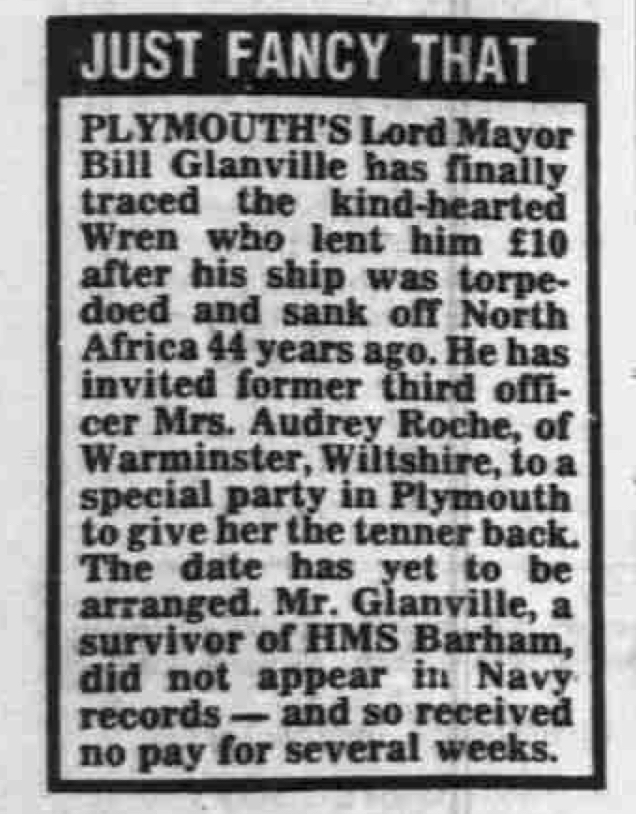
Just Fancy That
Grimsby Evening Telegraph, November 7, 1986, page 25
More on this remarkable person:
"Audrey Roche" [Obituary], The Daily Telegraph, February 5, 2009.
"Audrey Roche: Wren officer decorated for rescuing a drowning seaman" [Obituary], The Times, March 16, 2009.
Oral History: “Roche, Audrey Sylvia (Oral history)”, interviewed by Conrad Wood, March 29, 1993, Imperial War Museum Sound Archive, Catalogue number 13126. The recording is online: https://www.iwm.org.uk/collections/item/object/80012848
Jeremy A. Crang, Sisters in Arms: Women in the British Armed Forces During the Second World War, University of Edinburgh Press (2020), pages 245-247.
"Snippets/Pictures From the Past. Saving Life at Sea", Kenya Regiment Association mini-SITREP XXXV, December 2009
Hans Houterman & Jeroen Koppes "World War II unit histories & officers/Women's Royal Naval Service (WRNS) Officers, 1939-1945, Caddy, L.M.S. to Curtis, A.", https://www.unithistories.com/officers/WRNS_officersC.html